
//
by
Team Teya
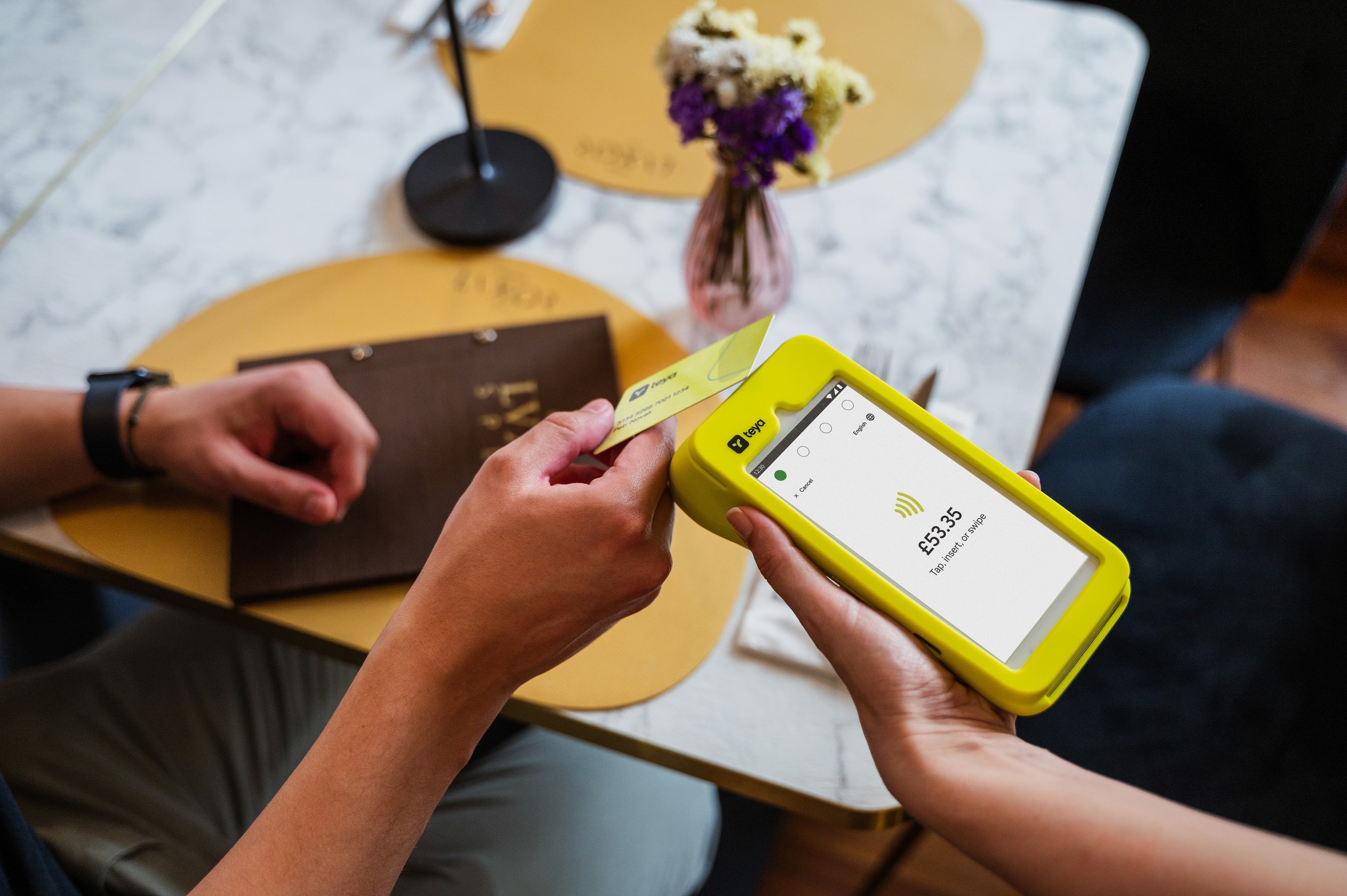
It is 2:00 PM on a Saturday. Your cafe is at capacity. The kitchen is pumping out orders, the coffee machine is hissing, and your floor staff are moving at a sprint. At table four, a group has finished their meal and is trying to catch a server's eye to ask for the bill.
They wait five minutes. The server brings the bill. They wait another five minutes for the server to return with the card machine. By the time they finally tap their card and leave, ten minutes of "dead time" has passed where that table sat empty while new customers waited at the door in a growing queue.
For UK hospitality owners, this "bill dance" is more than just a minor inconvenience—it is a leak in your bucket. In an industry where margins are being squeezed by rising food costs and energy bills, every minute a table sits "unproductive" is money lost.
"Pay at table" technology is no longer a luxury reserved for high-end London eateries; it has become the baseline for restaurant efficiency across the UK. But is it the right move for your specific business?
Why the Old Way is Killing Your Growth
Traditional payment setups often rely on a "fixed" point of sale. Your staff takes an order, walks to a central till, prints a bill, walks it to the table, and then eventually returns with a card machine tethered to a base station.
This back-and-forth movement is a waste of your most valuable resource: your team's time. According to recent 2025 data from UKHospitality, the sector continues to face a significant labour shortage, with vacancy rates 20% higher than pre-pandemic levels. When you are short-staffed, you cannot afford to have your team acting as human messengers for a piece of paper.
Beyond staff fatigue, there is the customer experience. Modern diners—especially the growing Gen Z and Millennial demographic—value speed and autonomy. A slow checkout process leaves a "sour taste" at the end of an otherwise great meal. If the last thing a customer remembers is the frustration of trying to pay, they are far less likely to become a regular member of your community.
The Benefits of Moving to the Table
1. Turning Tables Faster
The most immediate impact of pay-at-table technology is the reduction in "dwell time." When a server can print the bill and take the payment in a single journey, you can save between 5 to 10 minutes per booking.
Over a busy lunch service, this cumulative time saving allows you to fit in an extra "turn" for several tables. If your average spend is £40 per table, and you turn three extra tables a day, that is an additional £4,380 in revenue per month. This is the simplest way of turning tables faster without making your guests feel rushed.
2. Boosting Staff Morale and Tips
In 2024, the UK government passed the Employment (Allocation of Tips) Act, which makes it a legal requirement for 100% of tips to be passed to staff without deductions. This has put the spotlight on how businesses handle gratuities.
Pay-at-table terminals make tipping at the table effortless. By presenting clear percentage options (10%, 12.5%, 15%) on a private screen, you remove the social awkwardness for the customer. Data shows that digital tipping prompts can increase total tip volume by up to 25%, directly helping you retain your best talent in a competitive market.
3. Accuracy and Reduced Shrinkage
Manual entry is the enemy of a clean balance sheet. When a server has to remember a total from the till and type it into a separate card machine, mistakes happen. A misplaced decimal point or a forgotten "side of chips" adds up. Integrated pay-at-table systems sync your POS directly with the card machine, ensuring the amount on the screen is always correct.
The UK Market Context: Navigating 2026
The UK hospitality landscape is undergoing a transformation. The Office for National Statistics (ONS) reported that while food inflation has slowed, operating costs remain at historic highs. In this environment, "champion performance" isn't just a goal; it's a survival strategy.
Furthermore, the Financial Conduct Authority (FCA) has heightened its focus on operational resilience. Businesses are now expected to have robust systems that don't fail during peak hours. Relying on a single, aging Wi-Fi router for your card machines is a risk. Modern pay-at-table solutions use roaming 4G SIMs as a backup, ensuring that even if your "fibre" goes down, your ability to take money doesn't.
The Teya Solution: Built for Heartwarming Hospitality
We know that as a local business owner, you don't want to be an IT manager. You want to be a host. At Teya, we’ve designed our pay-at-table solutions to be "human-shaped"—intuitive for your team and seamless for your guests.
We don't just give you a piece of hardware; we give you a partner invested in your success. Here is why Teya is the choice for thousands of UK restaurants and cafes:
Fair, Transparent Pricing: We don't believe in the "hidden fee" culture of traditional UK banks. No PCI compliance shocks, no statement fees. You get a clear rate so you can plan your margins with confidence.
Next-Day Payouts: Cash flow is the heartbeat of your business. We ensure your settled funds hit your account by the next business day, even on weekends. You shouldn't have to wait for your own money.
Human Support: If your machine has a question at 8:00 PM on a Friday, you don't want a chatbot. You want a person. Our UK-based support team is made of real people who understand the urgency of a busy service.
Community First: We treat our customers as members of a community. We believe in the "Buy Local" movement and build tools that help independent businesses outperform the big chains.
Is It Right for You?
While pay-at-table technology offers huge benefits, it’s important to consider your service style:
Quick Service / Counter Service: If your customers pay before they sit (like a traditional chippy or a fast-casual deli), a fixed or "Tap to Pay" setup on a smartphone might be more efficient.
Full Service / Casual Dining: If you have table service, pay-at-table is a necessity. It keeps your staff on the floor where they can see if a guest needs another drink, rather than tucked away at a till.
Pubs and Bars: For busy bar environments, the ability to open a "tab" at the bar and close it at the table is a massive advantage for both staff and guests.
Investing in Your Future
The "bill dance" belongs in the past. As we move through 2026, the businesses that will thrive are those that embrace technology to enhance—not replace—the human touch.
By implementing pay-at-table solutions, you are giving your staff the tools to be more efficient, your guests the speed they crave, and your business the cash flow it needs to flourish. It is a small change that delivers a champion performance where it matters most: at the heart of your community.
Ready to see how Pay at Table can transform your service? Get started with Teya today and join a community of hospitality heroes built for the long run.